CMS Pro
CMS-Pro is an AI-powered Content Management System that leverages modern Large Language Models (LLMs) and agentic AI architecture to automate and enhance the entire content lifecycle. Rather than functioning as a traditional CMS, the platform incorporates intelligent AI agents capable of understanding user intent, generating high-quality content, refining existing articles, optimizing SEO, and assisting with editorial workflows through contextual reasoning. The system is designed around a modular, scalable architecture where specialized agents collaborate to perform complex multi-step tasks, enabling human-in-the-loop decision making while maintaining flexibility and extensibility. By combining retrieval, prompt orchestration, and autonomous task execution, CMS-Pro demonstrates how agentic AI can transform content creation into an intelligent, efficient, and adaptive workflow, significantly reducing manual effort while improving content quality and consistency.
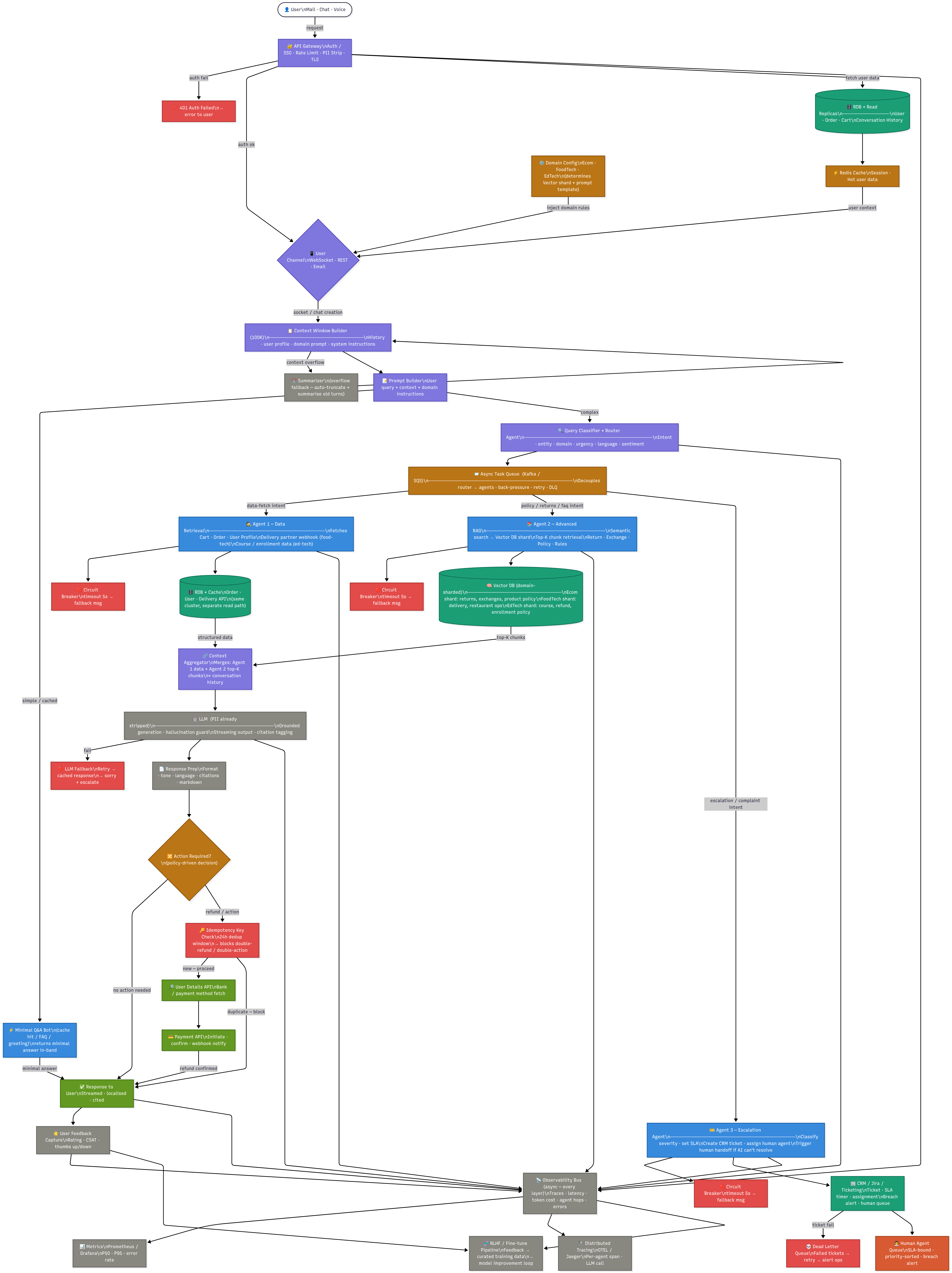
Why It Matters
AI support systems are not just chat interfaces. They have to protect sensitive input, ground answers in policy, route work to the right capability, preserve operational context, and fail safely when an external dependency is slow or unavailable. CMS Pro treats those concerns as first-class system design problems.
Engineering Focus
- Secure request boundary. FastAPI gateway with authentication, rate limiting, PII stripping, and a WebSocket path for streamed responses.
- Agentic orchestration. Kafka-backed routing coordinates data-fetch, retrieval-augmented generation, and escalation agents, with a multi-provider AI abstraction across Groq, Claude, GPT-4, Gemini, Ollama, and other providers.
- Grounded retrieval. Local sentence-transformer embeddings pair with ChromaDB for development and Pinecone for production, using hybrid retrieval and citations to keep answers tied to source policy.
- Production resilience. Circuit breakers, Redis and PostgreSQL idempotency controls, retries, fallback behavior, and async streaming protect user workflows from duplicate actions and dependency failures.
- Operational visibility. Prometheus, Grafana, and structured logs expose latency, error, token-cost, escalation, and SLA signals across the system.